
Protecting Your Money in a Digital World: Avoiding Financial Scams
The digital world has made managing money more convenient than ever. We can pay bills, transfer funds, invest, shop, and communicate with financial institutions from a smartphone. But the same technology that makes financial transactions easier can also give scammers new ways to target our money and personal information.
Financial scams are becoming increasingly sophisticated. Fraudsters may impersonate banks, government agencies, investment professionals, friends, or even romantic partners. They can use social media, text messages, emails, fake websites, and online advertisements to make fraudulent offers appear legitimate.
The good news is that awareness, patience, and good financial habits can help reduce your risk.
Why Digital Financial Scams Are So Dangerous
Traditional scams often relied on face-to-face interactions or phone calls. Today, scammers can reach thousands of potential victims through digital platforms almost instantly.
The Federal Trade Commission (FTC) reported that consumers lost more than $7.9 billion to investment scams in 2025, with a median individual loss of more than $10,000.
Scammers also use information gathered from social media and other online sources to make their messages more convincing. A message may include your name, reference a recent purchase, or appear to come from someone you know.
This is why protecting your finances requires more than simply watching your bank account. It also means protecting your identity, passwords, devices, and personal information.
Common Financial Scams to Watch For
1. Phishing and Fake Bank Messages
A scammer may send an email or text claiming to be from your bank, credit card company, payment provider, or another trusted organization.
The message might say:
“Suspicious activity has been detected.”
“Your account will be closed.”
“Verify your identity immediately.”
“Click here to confirm your transaction.”
The goal is often to convince you to click a fraudulent link or provide sensitive information such as your password, account number, or verification code.
The FTC recommends avoiding unexpected links and attachments and contacting the organization directly using information you know is legitimate.
Remember: If you receive a suspicious message from your bank, don't use the phone number or link provided in the message. Open your bank's official app or use a trusted website or phone number instead.
2. Investment Scams
Investment scams can be especially damaging because they target money people have worked hard to save.
Scammers may promise:
Guaranteed returns
Little or no risk
Extremely high profits
“Secret” investment strategies
Cryptocurrency opportunities
Exclusive investment opportunities
Guaranteed monthly income
The FTC emphasizes that all investments involve risk, and promises of unusually high returns with little or no risk are major warning signs.
Be particularly cautious when an investment opportunity arrives through an unsolicited social media message, online advertisement, or group chat.
The SEC has also warned about social-media investment scams in which fraudsters impersonate investment professionals or well-known financial personalities. Investors should verify the identity and registration status of anyone offering investment advice or opportunities.
3. Cryptocurrency and Relationship Scams
Some scammers build relationships with victims before introducing an investment opportunity.
For example, someone may contact you through social media or a dating app, develop a relationship with you, and eventually claim that they have discovered a highly profitable cryptocurrency investment.
They may encourage you to invest and even direct you to a professional-looking website or app that shows your account balance increasing.
But the displayed profits may be completely fake.
The FBI has warned about this type of cryptocurrency investment fraud, sometimes called “pig butchering,” where scammers build trust before persuading victims to make increasingly large deposits.
A relationship should never be the reason you trust an investment.
4. Impersonation Scams
Scammers may pretend to be:
Your bank's fraud department
A government agency
A financial professional
A family member or friend
A technology company
A delivery company
A law enforcement agency
One particularly dangerous version involves someone claiming that your money is at risk and that you must immediately move it to a “safe” account.
The FTC specifically warns consumers never to move money simply because someone tells them it is necessary to protect their funds. It also warns never to share verification codes with someone who contacts you unexpectedly.
If someone tells you to move your money urgently, stop and verify the situation independently.
Red Flags That Should Make You Stop
Scammers often rely on emotions rather than logic. They want you to feel fear, excitement, urgency, or trust before you have time to think.
Watch for these warning signs:
🚩 “You must act right now.”
Legitimate financial decisions generally deserve time and consideration.
🚩 “There is no risk.”
There is no legitimate investment that can guarantee high returns without risk.
🚩 “Keep this opportunity a secret.”
Scammers may discourage you from discussing an opportunity with family members, financial professionals, or others who might question it.
🚩 “Send money to protect your account.”
This is a major warning sign.
🚩 “Give me the verification code.”
Never provide a one-time verification code to someone who contacts you unexpectedly.
🚩 “Send payment by gift card, cryptocurrency, wire transfer, or another unusual method.”
Be extremely cautious when someone insists on a particular payment method, especially one that makes recovering the money difficult.
🚩 “I can guarantee your profits.”
Promises of guaranteed profits are one of the classic warning signs of investment fraud.
Five Ways to Protect Your Money
1. Slow Down
One of your strongest defenses against fraud is simply taking your time.
Scammers want you to make decisions before you have an opportunity to investigate.
Before sending money or providing information, ask yourself:
Who contacted me? How do I know they are legitimate? What happens if I wait?
If someone is pressuring you to act immediately, that's a reason to pause—not a reason to act faster.
2. Verify Before You Trust
Don't rely solely on the information provided by the person contacting you.
Instead:
Visit the organization's official website yourself.
Use a trusted phone number.
Check the person's professional credentials.
Research the company independently.
Search for complaints or reports of fraud.
Verify investment professionals through appropriate regulatory databases.
The FTC recommends researching investment companies and checking whether investment professionals or firms are properly licensed or registered.
3. Strengthen Your Digital Security
Protecting your money also means protecting your online accounts.
Consider:
Using strong, unique passwords.
Enabling two-factor or multi-factor authentication.
Keeping your phone and computer updated.
Using reputable security software.
Avoiding sensitive financial transactions on unsecured public networks.
Monitoring your financial accounts regularly.
Two-factor authentication provides an additional layer of protection if a password is compromised.
4. Protect Personal Information
Your personal information has value.
Avoid sharing sensitive information unnecessarily, including:
Bank account numbers
Credit card information
Passwords
Social Security numbers or other government identification numbers
One-time verification codes
Answers to security questions
Be careful about what you publicly share on social media as well. Information such as your birthday, address, workplace, family relationships, and travel plans can potentially be used by scammers to make fraudulent communications appear more believable.
5. Monitor Your Accounts
Don't wait until something feels wrong.
Regularly review:
Bank transactions
Credit card statements
Investment accounts
Retirement accounts
Credit reports
Email and account security notifications
Early detection can make it easier to respond when something suspicious happens.
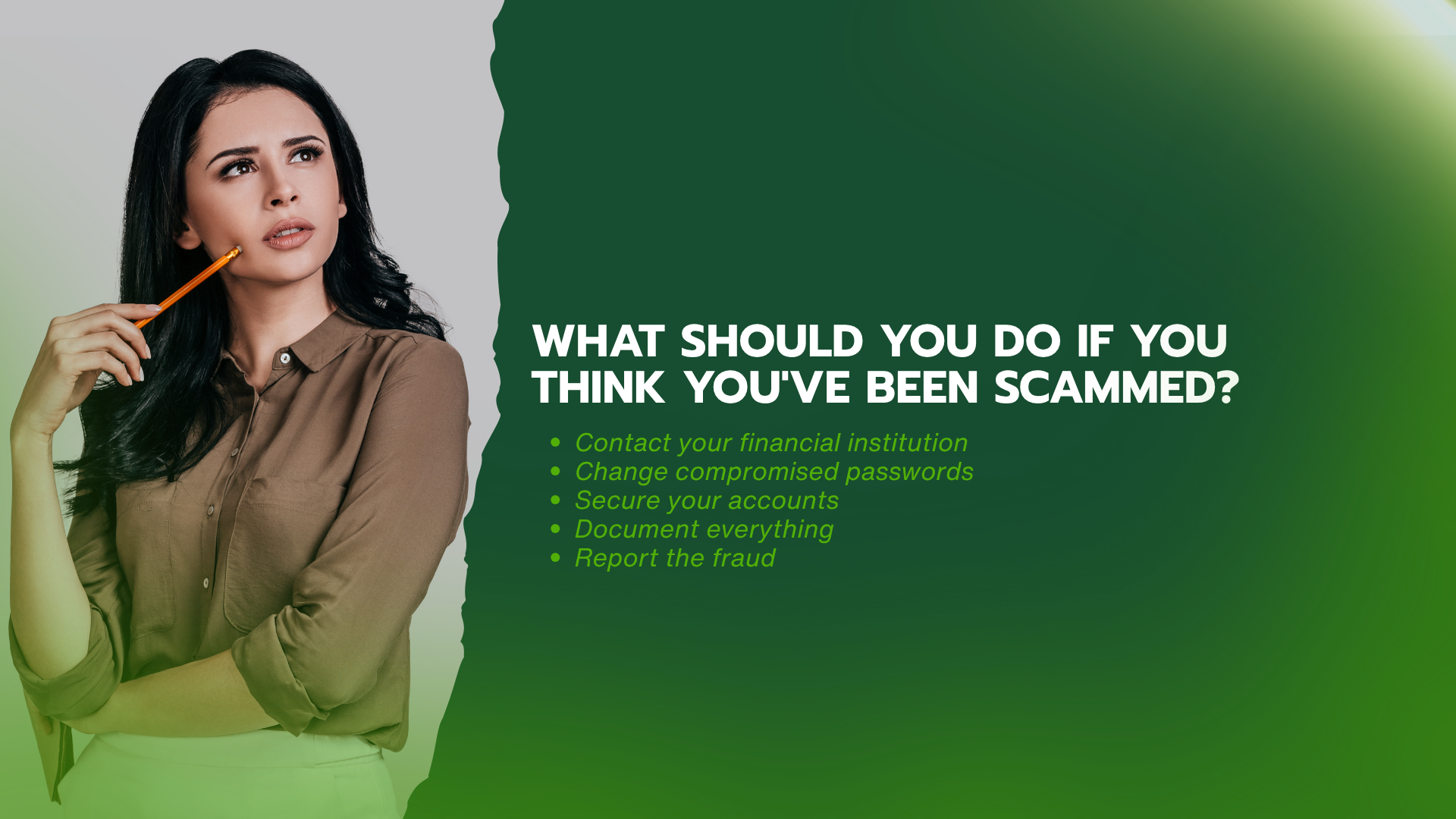
What Should You Do If You Think You've Been Scammed?
If you believe you've provided information or sent money to a scammer, act quickly.
Contact your financial institution
If money was transferred or your account information was compromised, contact your bank, card issuer, or financial institution immediately. Ask what steps are available to stop or reverse the transaction.
Change compromised passwords
If you gave a scammer your password, change it immediately. If you used the same password elsewhere, change those accounts too.
Secure your accounts
Enable multi-factor authentication and review recent account activity.
Document everything
Save emails, messages, phone numbers, transaction records, screenshots, receipts, and other information related to the scam.
Report the fraud
In the United States, investment scams can be reported to the FTC and SEC, depending on the circumstances. The FTC also provides guidance on what to do after you've been scammed.
If you're outside the United States, report the incident to your local financial regulator, law-enforcement agency, bank, or appropriate cybercrime reporting authority.
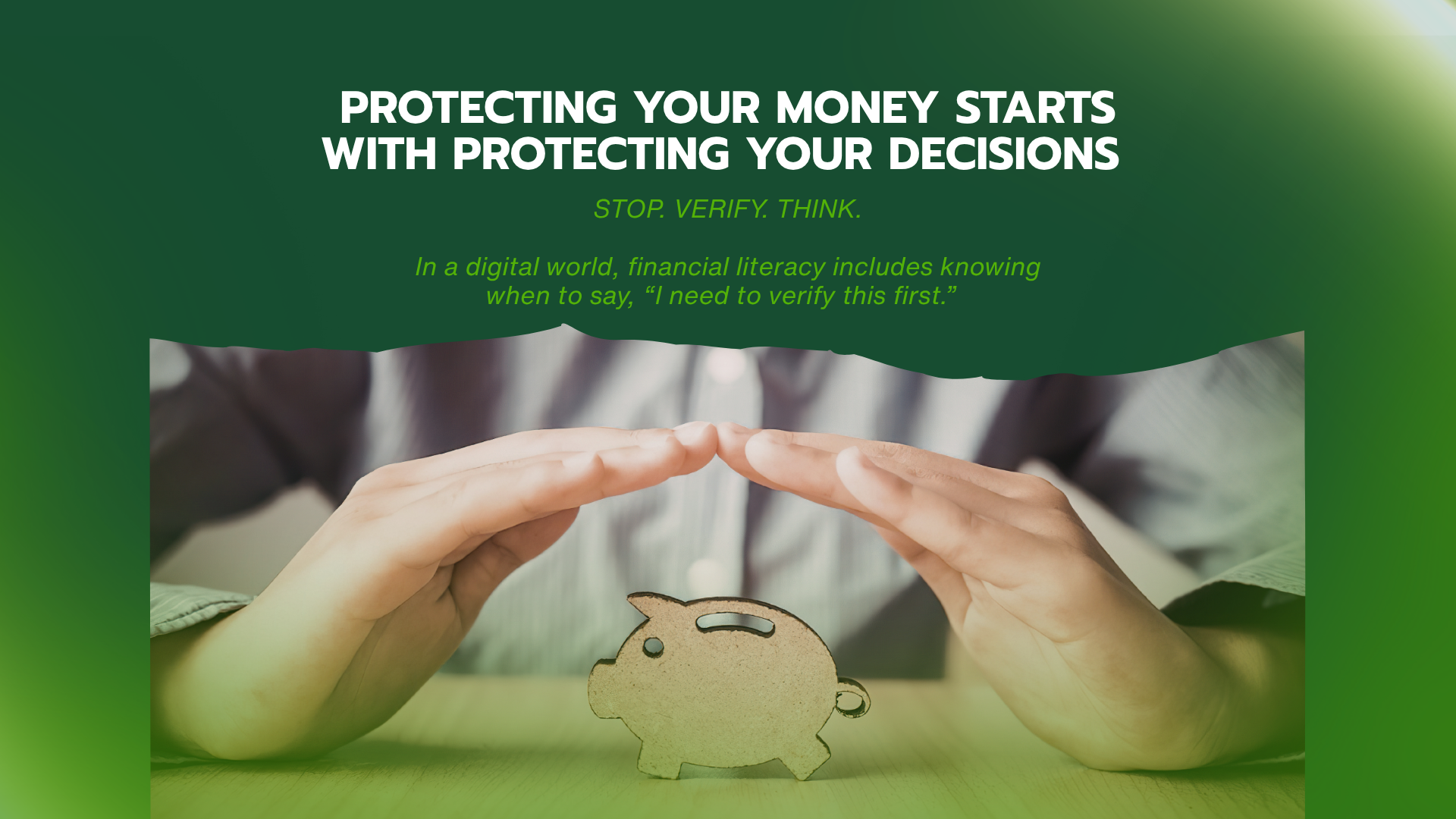
Protecting Your Money Starts With Protecting Your Decisions
Technology isn't the enemy. Digital banking, online investing, electronic payments, and financial apps can make managing money more convenient and efficient.
The key is to use technology carefully and intentionally.
Before making a financial decision online, remember three simple words:
STOP. VERIFY. THINK.
Stop before responding to an unexpected request.
Verify the person, company, investment, or financial institution independently.
Think about whether the opportunity makes sense before putting your money or personal information at risk.
Your financial security isn't just about how much money you save or invest. It's also about protecting the money you've already worked hard to build.
In a digital world, financial literacy includes knowing when to say, “I need to verify this first.”
Key Takeaways
Don't click unexpected financial links or attachments.
Never share passwords or one-time verification codes.
Be skeptical of guaranteed or unusually high investment returns.
Don't allow anyone to pressure you into making an immediate financial decision.
Independently verify financial professionals and investment opportunities.
Use strong passwords and multi-factor authentication.
Monitor your financial accounts regularly.
If something feels suspicious, stop and investigate before sending money.
When it comes to your money, taking a few extra minutes to verify can save you years of financial recovery.
References
Federal Trade Commission. Investment Scams. Consumer Advice. Accessed October 7, 2026. FTC Consumer Advice – Investment Scams
Federal Trade Commission. With people losing big to investment scams, learn how to spot and avoid them. April 2026. Accessed October 7, 2026. FTC Consumer Alert – Investment Scams
U.S. Securities and Exchange Commission. Social Media and Stock Tip Scams – Investor Alert. September 30, 2024. Accessed October 7, 2026. SEC Investor Alert
Federal Trade Commission. Protect yourself from phishing scams. April 2025. Accessed October 7, 2026. FTC Consumer Alert – Phishing Scams
Federal Trade Commission. Never move your money to “protect it.” That’s a scam. March 2024. Accessed October 7, 2026. FTC Consumer Alert – Money Transfer Scams
Federal Bureau of Investigation, Internet Crime Complaint Center. Cryptocurrency Investment Schemes. October 3, 2022. Accessed October 7, 2026. FBI IC3 – Cryptocurrency Investment Schemes
Federal Trade Commission. What To Do if You Were Scammed. Consumer Advice. Accessed October 7, 2026. FTC Consumer Advice – What To Do if You Were Scammed
U.S. Securities and Exchange Commission. Investor Alerts and Bulletins. Accessed October 7, 2026. SEC Investor Alerts and Bulletins
